
Study Visits to European Partner Universities
As a core component of the PhDGOV capacity building programme, participating delegations undertook a series of structured study visits to leading European universities. These visits provided in-depth exposure to diverse doctoral education systems, governance models, and institutional practices, allowing participants to directly observe how PhD programmes are managed, supported, and quality-assured in different European contexts.
Study Visit to Vrije Universiteit Brussel (Belgium)
The study visit to Vrije Universiteit Brussel focused on innovation, digitalisation, and stakeholder engagement in doctoral education. Hosted by the EU–China Higher Education Research Center (ECHE), the programme included visits to Brussels AI Labs and the VUB AI Experience Center, where participants explored advanced research environments and discussed the integration of artificial intelligence and digital tools in PhD governance and research management.
Sessions addressed the practical use of digital platforms for doctoral supervision, progress monitoring, and research administration, highlighting how technology can enhance transparency and efficiency in PhD programmes. In addition, participants were introduced to the Flemish PhD Stakeholder Engagement Panel, which promotes collaboration between universities, industry, and the labour market, with a particular focus on career development for PhD candidates and postdoctoral researchers.
The visit also included a dedicated meeting with VLIR-UOS, during which funding opportunities, international cooperation mechanisms, and capacity-building schemes were discussed. This meeting provided valuable insights into how strategic partnerships and external funding can support sustainable doctoral education reform.
Study Visit to KTH Royal Institute of Technology (Sweden)
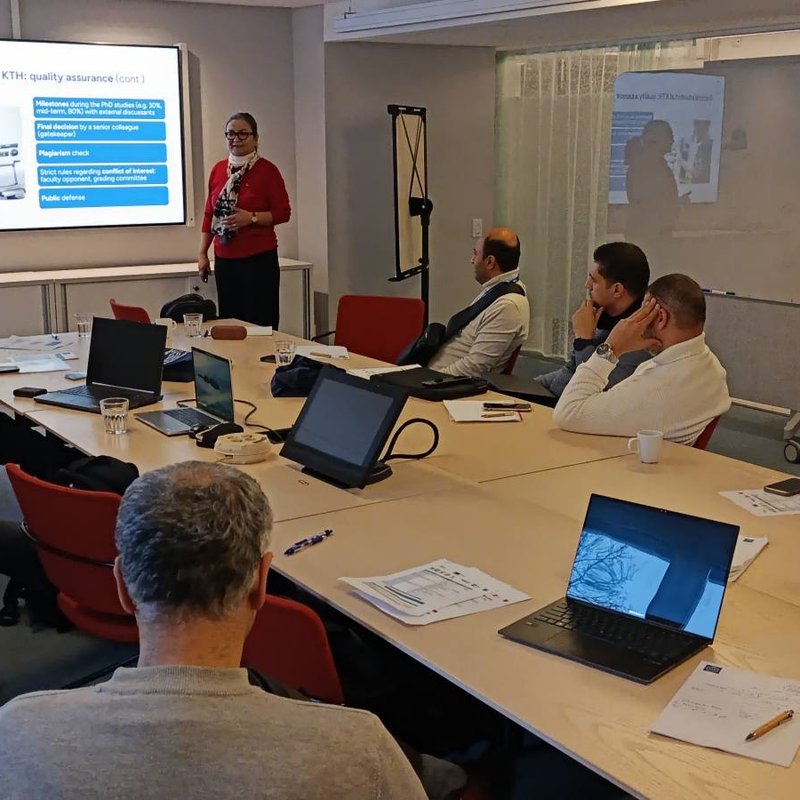
The study visit to KTH Royal Institute of Technology offered participants a comprehensive overview of the Swedish model of doctoral education across multiple disciplines. The programme covered doctoral pathways, supervision frameworks, quality assurance mechanisms, and structured training components, with a strong emphasis on clarity of roles and expectations for both PhD candidates and supervisors.
Particular attention was given to non-disciplinary doctoral training, professional skills development, and the integration of doctoral education with industry and society. Participants examined how KTH embeds university–industry collaboration within PhD research, ensuring relevance, employability, and societal impact. The visit also showcased KTH’s modern campus environment, advanced research infrastructure, and student-centered learning spaces, reinforcing the importance of supportive academic ecosystems for doctoral success.
Study Visit to RWTH Aachen University (Germany)
The study visit to RWTH Aachen University highlighted the German approach to doctoral education, characterized by strong links between academia and industry. The programme began at the SuperC Building with presentations on PhD culture at the faculty of mechanical engineering and on transfer and innovation policies, followed by visits to Campus Melaten, RWTH Campus GmbH, and RWTH Innovation GmbH, where participants explored large-scale research infrastructures and industry–research collaboration platforms.
Further sessions focused on PhD pathways in engineering and natural sciences, addressing formal procedures, quality management systems, evaluation standards, and supervision practices. Participants also engaged with examples of joint industry–academia PhD projects and visited the Collective Incubator, which supports student entrepreneurship and innovation. The visit concluded with an overview of the RWTH Center for Young Academics, highlighting institutional support services for doctoral researchers.
Added Value of the Study Visits
Together, the study visits provided participants with comparative perspectives on doctoral governance, supervision, quality assurance, digitalisation, and industry engagement. The insights gained directly informed the development of institutional action plans and strengthened the capacity of Palestinian universities to implement sustainable reforms aligned with international best practices.